Troubleshot All Day, Finally Restored Proxy Speed to Gigabit Level
Two main things were done.
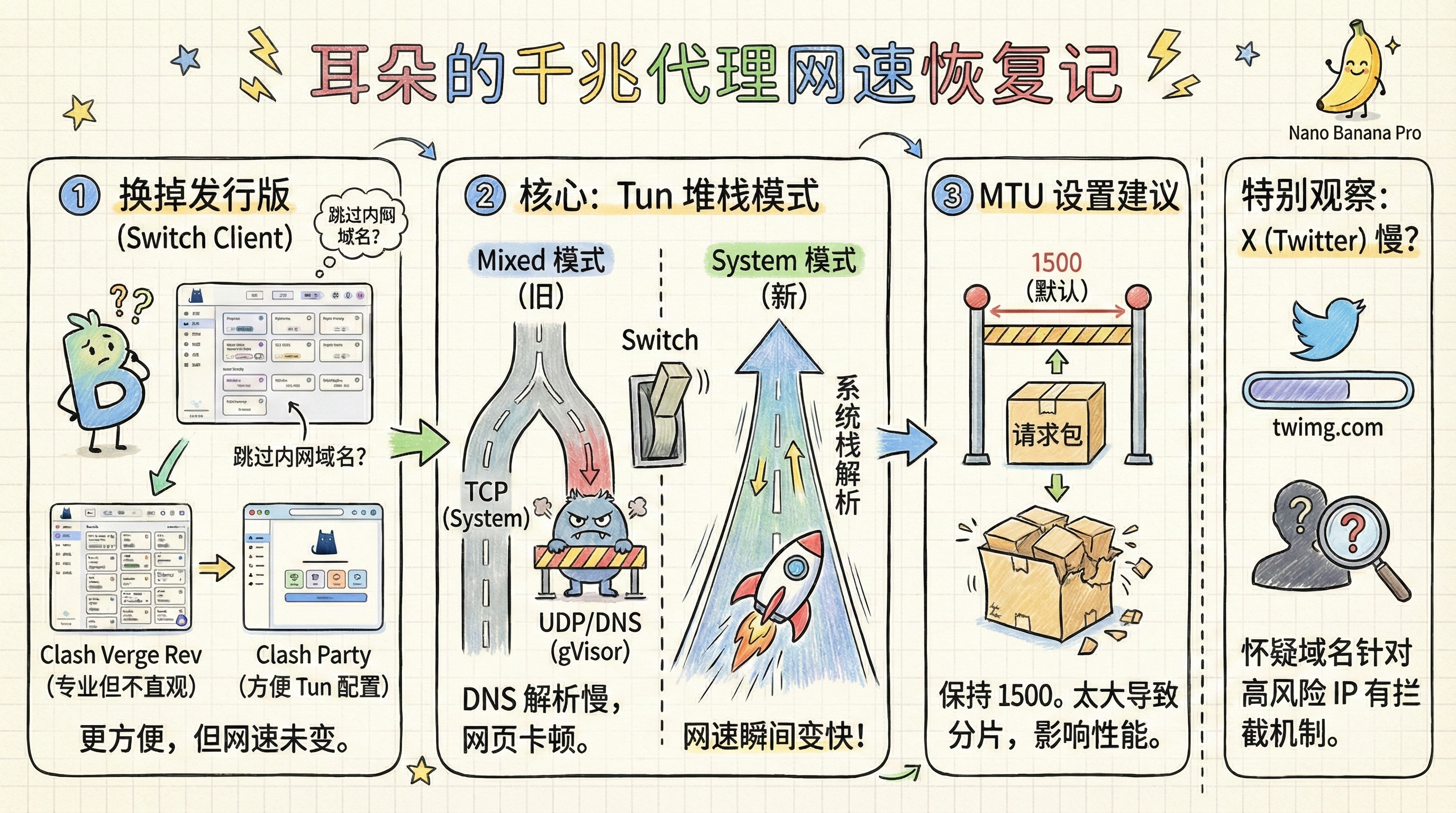
1. Switched Clash Distribution
I switched from Clash Verge Rev to Clash Party, even though all the AI assistants told me that Clash Verge Rev is the more professional and feature-rich choice.
However, I never properly figured out how to skip private network domain resolution in Tun mode, which is quite important when working at a company. Clash Party has this configuration built-in when you enable Tun mode—very convenient.
After switching, web browsing didn’t get any faster, so the speed issue wasn’t related to the distribution—it’s just that this one is more convenient to use.
2. Tun Stack Mode
Next, I changed the stack mode under Tun (virtual network card) mode from Mixed to System.
- Mixed is hybrid mode: TCP requests go through System mode (netstack), UDP requests go through gVisor mode.
- System mode: Both TCP and UDP go through the system stack for resolution.
The reason web browsing might feel sluggish is slow DNS domain resolution. Since DNS resolution is also a UDP request, it goes through gVisor in Mixed mode.
After switching to System mode, DNS directly goes through the system stack, and the overall network speed instantly improved—confirming my suspicions.
3. Other Thoughts
Another key configuration in Clash Tun mode is MTU, which sets the maximum packet size for requests. It’s recommended to keep the default 1500 and not increase it.
Increasing it actually makes things worse because you can’t guarantee that all devices along the network path have large MTU values. This means larger packets may need fragmentation, which impacts performance and is particularly unfriendly to UDP requests.
Among all the websites I tested, X (formerly Twitter) is the slowest. Its slowness mainly comes from some JS files loaded on the initial page render. The domain used to request these JS files also hosts X’s image resources, so the images often load slowly as well.
After running global speed tests on this domain, I suspect it has some special blocking mechanisms—for example, proactively slowing down requests from high-risk IPs.