Five Insights from Altman: AI, Entrepreneurship, and the Future
After watching OpenAI CEO Altman’s live interview, I want to share five high-value perspectives on AI, the future of software engineering, GTM bottlenecks, competitive moats for AI products, GPT-5’s writing struggles, and the most critical skills in the AI era.
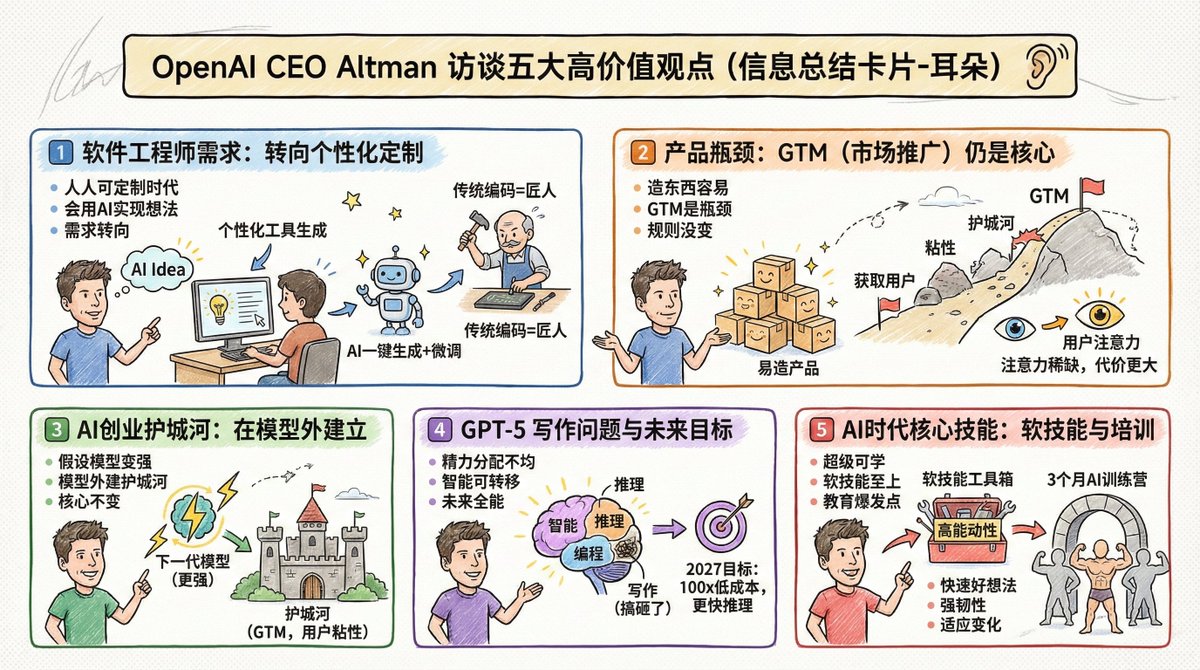
1. AI Makes Code Creation Extremely Cheap — Will Software Engineer Demand Decrease or Increase?
Altman’s view: The future will see a surge of software written specifically for one person or a very small team, with everyone continuously customizing their own tools.
His implicit message is clear — demand for traditional professional software engineers will decline. I completely agree.
Not that engineers will disappear, but we’re shifting toward an era of “human-customizable” software. AI generates code with one click plus fine-tuning. What becomes truly valuable is people who can use AI to rapidly implement personalized ideas.
In the future, people who hand-write code from scratch might be called artisans.
2. Will AI Make Product Creation Easier?
Altman’s view: The real bottleneck for products was never building things — it’s GTM (Go-To-Market).
When Altman was at YC, founders kept complaining: “I thought the hardest part was making the product, but the hardest part was getting anyone to care about it or use it.”
AI has dramatically reduced the cost of building software, but acquiring users, solving GTM, building stickiness, and creating competitive moats — none of these rules have changed.
So even if AI assists with marketing, human attention remains an ultra-scarce commodity, and you may need to invest far more than before to capture user mindshare.
3. How to Build Competitive Moats for AI Products?
Altman’s view: Suppose the next generation of models becomes incredibly powerful — is that good or bad for your business?
Altman’s point here is essentially: always assume models will keep getting more powerful, then build your competitive moat from other dimensions. It could be GTM, it could be user stickiness — none of these dynamics have changed.
4. Why Did GPT-5 Mess Up Writing?
Altman admitted: GPT-5 compromised on writing. They invested most of GPT-5’s energy into intelligence, reasoning, and coding, with limited bandwidth — excellence in all areas was simply impossible.
But he believes a single model will eventually excel at all dimensions because “intelligence is transferable.”
By the end of 2027, OpenAI aims to provide GPT-5.2x-level intelligence at 100x or lower cost, with dramatically improved inference speed.
5. The Most Critical Skills in the AI Era?
All soft skills, and highly learnable. There are no longer obvious silver-bullet options like programming.
Altman says the truly core skills are: high agency, rapidly generating good ideas, exceptional resilience, and strong adaptability to a fast-changing world.
Since moving into startup investing, his biggest insight has been: putting people through a three-month intensive bootcamp-style program can make them extremely capable in these dimensions.
So this might be the breakout opportunity for future training and education institutions — using AI combined with sound processes to rapidly scale human productivity.